

In today’s fast-paced work environment, adequate “rest” is often reduced to getting a good night’s sleep or taking annual leave. Yet even after a weekend off or a full eight hours in bed, many professionals return to work still feeling drained – mentally foggy, emotionally flat, or creatively blocked.
Dr. Saundra Dalton-Smith noticed the same issue among her patients: people who were sleeping well but still felt chronically tired. Her research led to the Seven Types of Rest framework – a model that expands our understanding of rest far beyond just the physical.
This framework is especially relevant in the modern workplace. It recognises that exhaustion shows up in multiple dimensions – mental, emotional, sensory, social, creative, and spiritual – and that each requires a different kind of recovery. When leaders and teams learn to recognise and prioritise all seven types, they not only improve individual wellbeing but also enhance focus, engagement, and sustainable performance.
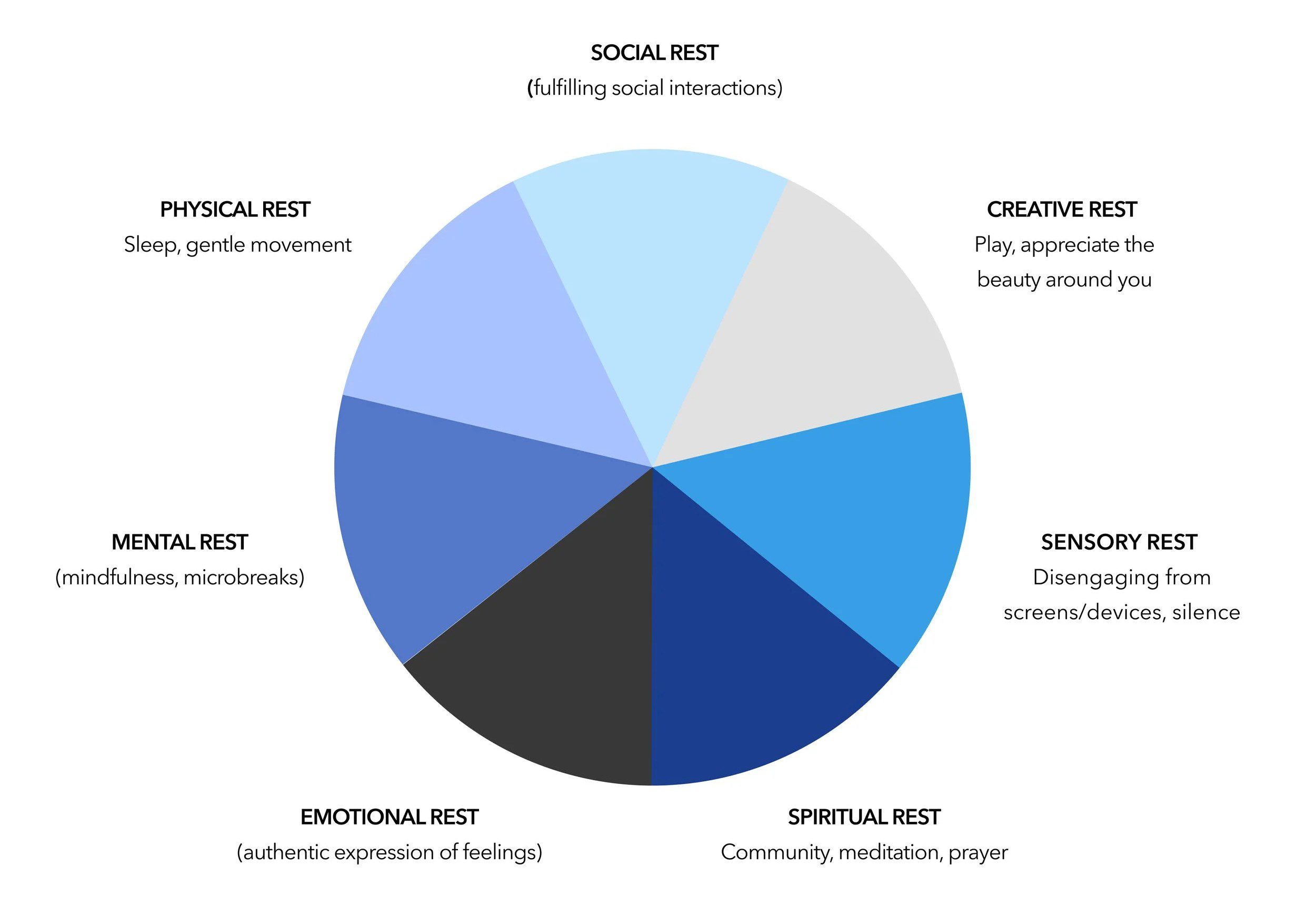
1. Physical Rest
Rest that restores the body and prevents physical burnout. It includes passive rest (napping, lying down) and active rest (stretching, massage).
Signs of depletion: Fatigue, tension, chronic pain, trouble focusing or staying awake.
Ideas to improve physical rest:
- Support flexible schedules that allow for genuine rest and recovery – take breaks, even if it’s just to go and make a cup of tea or coffee.
- Ensure passive rest – 8 hours of sleep each night if you can – don’t compromise on sleep! There is a myriad of evidence on the importance of sleep for overall wellbeing.
- Promote active rest – such as walking meetings, stretch breaks, or ergonomic workspaces. You only need 5 minutes to do a quick lap around the office!
2. Sensory Rest
Relief from constant sensory input – screens, notifications, noise, and multitasking. Even driving home from work is a sensory drainer.
Signs of depletion: Irritability, overstimulation, or difficulty focusing after long periods of screen time.
Ideas to improve sensory rest:
- Encourage device-free breaks and quiet zones outside of work – meditation or mindfulness activities are helpful here.
- Reduce visual and auditory overload in office design (close the door for protected time, move somewhere quiet periodically if you’re in an open plan space).
- Close your eyes for 30 seconds – you can do this while waiting for the kettle to boil or on a bathroom break – it doesn’t have to be huge!
3. Mental Rest
Giving the mind a break from constant analysis, problem-solving, and decision-making.
Signs of depletion: Mental fog, forgetfulness, and racing thoughts that don’t switch off after hours.
Ideas to improve mental rest:
- Set firm boundaries and avoid poor work habits (working outside of hours, not taking lunch breaks, saying yes when you have no capacity).
- Encourage reflection time – short pauses between meetings or projects. Write down notes or to-do lists during reflection to avoid mental clutter.
- Keep a notepad by your bedside table – write down anything that comes into your mind that keeps you awake, or you don’t want to forget. This allows you to go back to your notes during work hours to continue processing at more productive times.
- Do something creative or tactile when you can; painting, arts & crafts, mowing the lawns – whatever works for you. Get out of your head and into your body.
4. Social Rest
Balancing energy between relationships that are supportive and those that are draining.
Signs of depletion: Feeling lonely despite teamwork, emotionally exhausted from constant interaction or you find yourself isolating from friends and family.
Ideas to improve social rest:
- Foster psychologically safe, supportive team cultures.
- Normalise setting boundaries and taking time for solitude when needed. It’s okay to say no to a social event if you feel the need to have alone time.
- Make time for those in your social calendar that energise you – friends or family that you can be your authentic self with.
- Take social breaks during your workday – establish protected time routines. Close your door, put your phone on DND for 5 minutes or take a solo break after long or interactive meetings.
5. Creative Rest
Reawakening inspiration, curiosity, and problem-solving energy.
Signs of depletion: Feeling uninspired, stuck, or disengaged from innovative thinking.
Ideal to improve creative rest:
- Build time and space for innovation and brainstorming without pressure – a 10-minute brainstorming session with likeminded colleagues or mind-mapping on a whiteboard – don’t get caught up in finding a solution during these sessions, it’s just about getting ideas flowing.
- Encourage exposure to art, nature, or different environments that spark your creativity.
- Engage in creative hobbies when you can; this looks different to everyone but playing/listening to music, arts & craft, woodworking or gardening are some good ideas creative outlets.
6. Emotional Rest
The ability to express emotions authentically and without fear of repercussion.
Signs of depletion: Emotional numbness, irritability, or resentment toward work or colleagues.
Ideal to improve emotional rest:
- Create safe spaces for honest conversations and feedback at work where possible.
- Use wellbeing programs or employee assistance services – you don’t need to have a major concern before engaging in these services, you can use professional help as a way of processing and reflecting on your work, life or recovery.
- Reflect on your own implicit bias or self-stigma beliefs – do you struggle to express your emotions or seek help from others? Do you feel like a burden if you need to debrief with a trusted colleague? These are self-limiting beliefs and should be explored further to avoid barriers to emotional rest.
- If professional support feels like a barrier for you, pick one person you can go to that you feel safe to debrief with – inside or outside of work. Your leader, your partner or a friend. Talk with them regularly about what you’re experiencing and brainstorm ideas together on how you can overcome challenges.
- For empaths or those who feel deeply, ensuring you have protected time routines is vital. Incorporate alone time without interruption into your schedule or even take a solo coffee break when you’re feeling emotionally overwhelmed. Small breaks help avoid the compounding impact of others’ emotions.
7. Spiritual Rest
Connecting to a sense of purpose and belonging beyond day-to-day tasks.
Signs of depletion: Feeling disconnected from purpose or questioning the “why” behind life or work.
Ideal to improve spiritual rest:
- Reinforce organisational values and meaningful goals; what do these look like for you? How do they resonate? How will you improve or achieve them?
- Take part in mentoring or community engagement when possible in your work, supporting others (in a healthy way) is a great way to find purpose again.
- Connect with something bigger than yourself; religion, spirituality, or even just immersing yourself in nature. Use whatever feels right for you to encourage big-picture thinking and avoid getting stuck in the small stuff.
Rest is not the opposite of productivity – it’s what makes productivity possible. When teams only focus on physical rest (like sleep or holidays), they often overlook other dimensions of fatigue that quietly erode engagement, innovation, and wellbeing.
By adopting the Seven Types of Rest framework, you can take a proactive approach to burnout prevention and sustainable performance. The goal isn’t just to help employees “recover” – it’s to build workplaces where people can consistently show up focused, creative, and energised.



0 Comments