Prioritisation Safety: Making it safe to rationalise workload
I’ve been sitting on this concept for more than a year because I was reticent to introduce yet another “P something Safety” concept into the ether.
But, in my work I keep seeing a gap and a need for further support around this issue, so, here it is. You are getting the first view of this concept and my model.
Prioritisation Safety is the state in which there is organisational permission to constructively prioritise workload in alignment with strategic priorities.
Prioritisation Safety requires transparency over workload (job demands) meaning an openness and constructive approach to monitoring, measuring and managing workload and organisational permission to rationalise activities and tasks based on strategic priorities.
Strategic success is the goal.
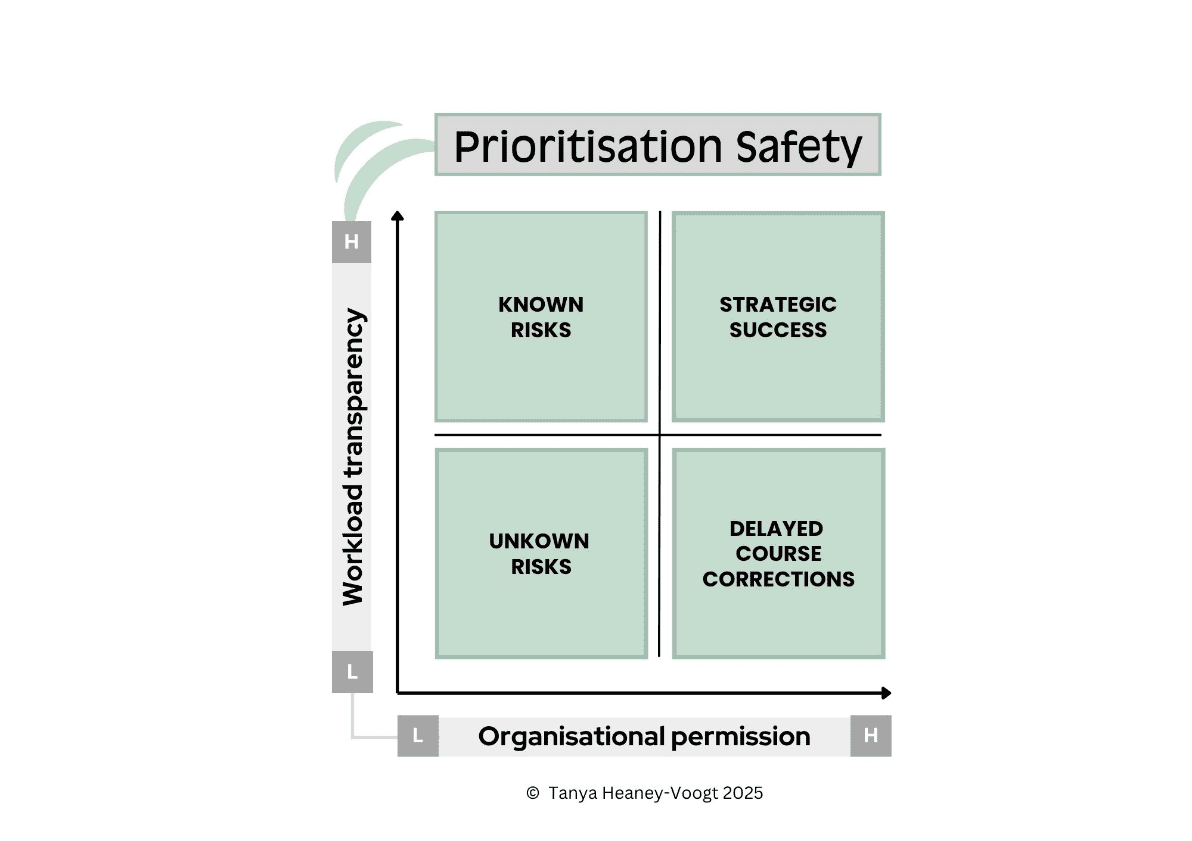
When workload transparency is high, and organisational permission to prioritise is high, open and constructive conversations about job demands and people’s capacity are being held, and with permission to rationalise and prioritise, constructive decisions are made aligned to organisational strategy.
Known Risks
If workload transparency is high, where the balance between job demands and capacity is transparent, but there is no organisational permission to rationalise activities and tasks where needed – then we are ignoring the risks associated. These risks may be to strategic goal achievement and/or psychosocial risks associated with chronic unmanaged work stress.
Delayed Course Corrections
If we give people permission to prioritise, but we have no way of monitoring, measuring or managing job demands – therefore low workload transparency – then any course corrections needed to address risks are delayed. Workload transparency and constructive discussions are essential to prioritisation safety.
Unknown Risks
If there is a low appetite for workload discussions and for prioritising or rationalising in your workplace then you are essentially like a ship navigating ice fields without radar or lookouts. The likelihood of running into trouble is high.
This concept is represented in the 2 x 2 model below.
Where would you rate your workplace if you were to draw on the model?
Where do you need to focus? On the X (permission) or Y (workload) axis? Or both?
Getting Unstuck
I’ve noticed five distinct levels for leaders and workplaces to move from being a little stuck to achieving prioritisation safety and strategic success.
Let’s explore each level:
Level 1 – Stuck
At this stage, your organisation is feeling the pressure, but no one quite knows what to do about it. People are stretched, decisions are reactive, and there’s a quiet undercurrent of fatigue or frustration. Leaders know there’s concerns as concerns around work stress are becoming more common. The risk here is normalising the discomfort. The opportunity is in recognising the “stuckness” and acknowledging the current reality without blame. What is your data telling you? What evidence do you have that points to the reality of your current state?
Level 2 – Surface
This is where honest conversations begin. You surface the concerns around workload and competing priorities. It might feel uncomfortable, but when executives listen without defensiveness and genuinely invite concerns to be aired, it builds workload transparency, making it safe to constructively monitor, measure and manage workload. Surfacing the issue doesn’t solve it, but it’s a critical first step.
Level 3 – Sense
You have a more informed understanding of what’s really going on beneath the surface. You look beyond symptoms and start seeing patterns. Things like poor role clarity, over-reliance on key people, or constant urgency. This stage is about insight. It’s where you stop hearing “we’re busy” and instead learn “we’re overloaded in the wrong areas” or “we’re prioritising the wrong things” or “we’re still doing the things the way we did 10 years ago.” Try Scanning for ROT as an early win. See this blog.
Level 4 – Shift
This is the first sign of progress. Leaders test a change. They start talking transparently about work volumes and timelines. Maybe they create a central register of projects for better visibility (highly recommended – see blog for a template). They might firm up what is in and out of scope for the year ahead to ensure laser sharp focus. They might start talking about prioritising rather than “we’re all busy, it just needs to be done.” Leaders might pause or park a low-impact initiative to breathe life into a high-impact initiative that’s been stalled. They might look at rebalancing team responsibilities against the strategic plan, parking a “nice to have” to ensure the “must have’s” get attended to.
Level 5 – Strategic
You’re now leading conversations about workload openly, transparently and frequently. It’s common parlance. You’ve aligned your strategic goals with your capacity, and you’ve created the systems and conditions for your people to do the most valuable work. Strategic leadership in this context means asking and listening deeply, acting deliberately to course correct in real time, and designing a system of work that supports both performance and wellbeing, reducing regulatory, reputational, and human risks. It means strategic success.
Where would you rate your workplace?
What’s one action you will take to move towards Strategic if you’re not already there?
Need support rationalising priorities? Reach out to chat about how I support teams to do this.




0 Comments